
Introduction
Cleanrooms require controlled airflow, filtration, pressure, temperature, and humidity to protect products and processes. These requirements make cleanroom facilities more energy-intensive than conventional industrial spaces, particularly when they operate continuously and maintain strict environmental conditions.
However, energy efficiency should not be achieved by simply reducing airflow, weakening pressure control, switching off critical systems, or extending maintenance intervals beyond safe limits. In regulated manufacturing, an uncontrolled energy-saving measure can create contamination risks, process instability, failed validation, or product loss.
The better approach is to improve the way the facility generates, distributes, monitors, and uses conditioned air and utilities. A well-designed Modular Cleanroom Solutions project can combine contamination control, energy management, maintainability, and future flexibility from the earliest engineering stage.
This means evaluating HVAC capacity, room classification, occupancy, equipment loads, FFU operation, pressure cascades, filter condition, temperature control, utility consumption, and production schedules as one connected system.
The goal is not simply to consume less energy. The goal is to achieve the required cleanroom performance with the lowest practical lifecycle cost while preserving GMP compliance, product quality, operational stability, and validation status.
Why Cleanrooms Consume Significant Energy
The largest energy demand in many cleanrooms comes from HVAC operation. Air must be filtered, conditioned, moved, recirculated, and sometimes exhausted continuously. The system may also need to maintain pressure relationships between several rooms with different cleanliness or containment requirements.
Air treatment becomes more demanding when the facility must control temperature and humidity within a narrow range. Outdoor air, process heat, equipment exhaust, seasonal weather, and frequent door opening can all increase the load on the system.
Filtration also affects energy consumption. As filters collect particles, their resistance increases. Fans then require more power to maintain the required airflow. Poorly maintained filters, blocked coils, leaking ducts, unbalanced dampers, and inefficient fans can increase energy use without improving room performance.
Cleanroom equipment adds another layer of demand. Production tools, sterilizers, ovens, compressors, pumps, lighting, inspection systems, and electrical cabinets may generate heat that the HVAC system must remove.
Utility systems can contribute significantly to total facility consumption as well. Compressed air, chilled water, purified water, process gases, vacuum, exhaust treatment, and backup power all need to be considered in the overall energy model.
A sustainable cleanroom design therefore begins with a clear understanding of the process rather than applying the same energy strategy to every room. A pharmaceutical filling room, semiconductor process area, medical device assembly room, and electronics facility have different cleanliness, temperature, humidity, equipment, and operating requirements.
Optimizing HVAC Without Weakening Cleanroom Control
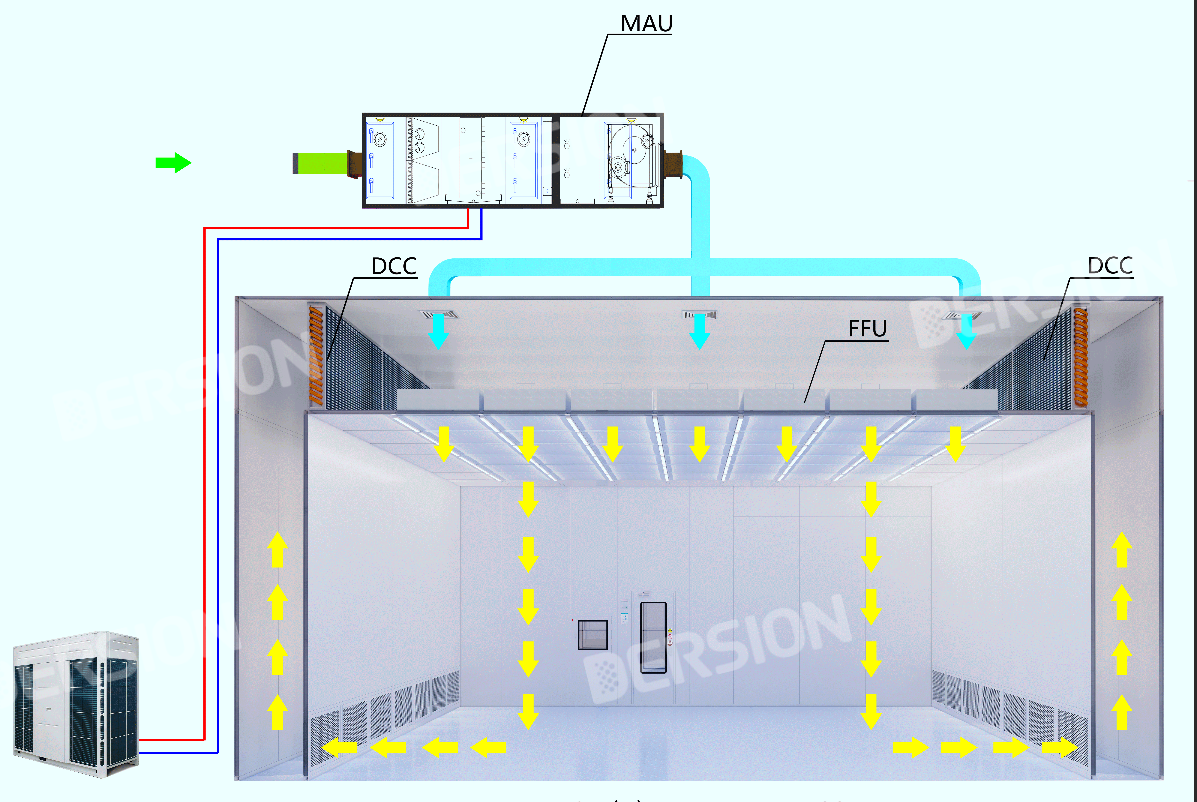
HVAC optimization should be based on the approved room classification, process risk, occupancy, equipment load, and operating state. The Cleanroom HVAC design should define how supply air, return air, exhaust, filtration, temperature, humidity, and pressure control work together.
One important opportunity is to avoid treating every room as if it has the same operating requirement. Storage areas, material staging rooms, corridors, gowning spaces, production rooms, and critical processing zones may require different airflow rates and environmental conditions.
Variable-speed fans, properly selected motors, demand-based control, and optimized air-handling sequences can help the HVAC system respond to actual operating conditions. During approved low-occupancy or non-production periods, the system may be able to operate under a defined setback strategy.
For sterile or regulated production, energy optimization must remain subordinate to the approved contamination-control strategy. The EU GMP Annex 1 guidance emphasizes the importance of contamination control, cleanroom conditions, pressure relationships, environmental monitoring, and facility operation.
Improving FFU, HEPA, and Airflow Efficiency
Fan filter units can provide flexibility in modular cleanrooms, but their energy performance depends on fan selection, control strategy, filter resistance, room layout, and maintenance.
HEPA filter pressure drop is an important energy indicator. As filters become loaded, the fan must work harder to maintain airflow. The ISO 14644-1 cleanroom classification standard provides a framework for classifying air cleanliness by airborne particle concentration.
Using Smart Monitoring and Energy Data
Energy efficiency improves when the facility can measure where energy is being used and how consumption relates to cleanroom performance. An energy monitoring system may track HVAC electricity, chilled water, heating, compressed air, process gases, and FFU power.
The cleanroom environmental monitoring program should therefore be reviewed together with energy data. Trends in pressure, temperature, humidity, particle levels, alarms, and recovery performance can help confirm whether an efficiency measure is operating safely.
Managing Heat Loads, Utilities, and Equipment Interfaces
Energy efficiency depends heavily on how production equipment and utilities interact with the cleanroom. Equipment heat loads should be included in HVAC calculations from the design stage. The Cleanroom Utility Systems design should evaluate compressed air, process gases, chilled water, and exhaust as part of the facility energy strategy.
Balancing Sustainability with GMP and Validation
Sustainable design must be compatible with the facility’s quality and validation requirements. The Cleanroom Contamination Control Strategy should define which environmental conditions are critical.
The cleanroom validation IQ OQ PQ framework should be used to assess significant energy-efficiency modifications, ensuring product protection is never compromised.
Designing for Lifecycle Energy Performance and ROI
Energy efficiency should be evaluated across the full lifecycle of the cleanroom. A more efficient lifecycle strategy may include high-performance motors, suitable fan control, and advanced monitoring. The financial return should be assessed through total cost of ownership, including maintenance, energy, and production continuity.
Conclusion
Cleanroom energy efficiency is not about reducing controls without understanding the consequences. It is about designing and operating the facility so that every unit of energy contributes to the required level of cleanliness, environmental stability, process protection, and production performance.
Dersion can coordinate modular cleanroom architecture, HVAC, process utilities, environmental monitoring, validation support, and lifecycle planning to create facilities that are more efficient, adaptable, and easier to operate over time.
Post time: Oct-22-2026