
In the world of controlled environments, the HVAC (Heating, Ventilation, and Air Conditioning) system is the vital organ that sustains life—or rather, sterility. Beyond mere temperature control, effective Cleanroom HVAC design is the primary defense against airborne particulates. At its core lies the delicate balance of differential pressure, ensuring that air flows only from the cleanest zones to less-clean areas.
A robust contamination control strategy relies on maintaining a "cascade" of pressure. Typically, the primary manufacturing area (Class A or ISO 5) is kept at the highest positive pressure.
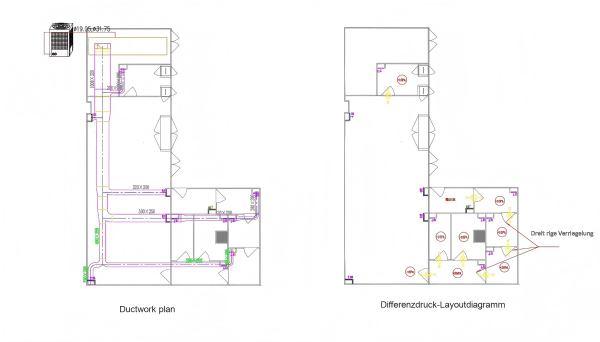
The design must also consider how air moves. For high-cleanliness zones (ISO 5 and above), unidirectional (laminar) airflow is essential to "sweep" particles away from the product surface. For ISO 7 or 8 areas, turbulent airflow with high air change rates (ACR) is often sufficient to dilute and remove contaminants.
Modern B2B projects in the US and Germany are increasingly focusing on sustainability. Dersion’s integrated HVAC solutions feature:
Cleanroom design is an exercise in precision engineering. By mastering the interplay between HVAC capacity and pressure gradients, Dersion helps global clients achieve a stable, compliant, and energy-efficient environment.
Post time: Jul-28-2026