
Introduction
In the competitive landscape of pharmaceutical manufacturing, semiconductor fabrication, and biotechnology, the environment isn’t just a workspace—it’s a critical asset. Traditional cleanroom construction, with its long lead times and on-site dust, is rapidly being replaced by Modular Cleanroom Solutions.
At Dersion, we redefine cleanroom agility. This guide explores the engineering, compliance, and financial logic behind modularity, helping global facility managers make informed decisions for their next high-stakes project.
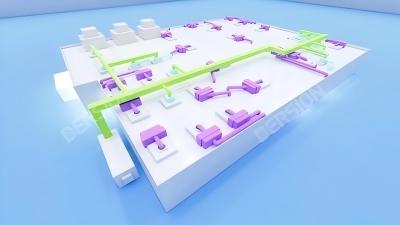
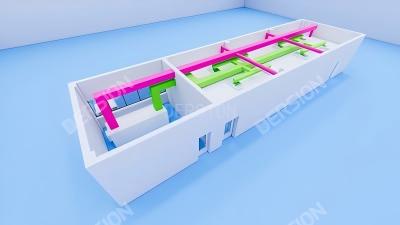
1. Modular vs. Traditional Cleanroom Construction
Why are global leaders shifting away from civil engineering? The answer lies in the fundamental difference in approach.
The Prefabrication Advantage
Modular cleanrooms are engineered in a factory-controlled environment. Every sandwich panel and FFU (Fan Filter Unit) is precision-cut to millimeter accuracy.
- Speed to Market: Assembly on-site is up to 50% faster than traditional methods.
- Minimal Disruption: Prefabrication means 80% less on-site dust and noise, allowing existing operations to continue.
- Flexibility: Unlike permanent walls, modular systems can be expanded, reconfigured, or relocated.
2. Navigating Global Compliance: ISO 14644 & GMP
A cleanroom is only as good as its certification. For US and EU markets, adherence to international standards is non-negotiable.
ISO 14644-1 Classification
Our modular solutions are designed to achieve specific particulate counts, from ISO 5 (Class 100) to ISO 8 (Class 100,000).
- ISO 5: Critical for aseptic filling and semiconductor lithography.
- ISO 7/8: Standard for medical device assembly and general pharmaceutical secondary packaging.
Pharmaceutical GMP Compliance
For drug manufacturers, we align our modular designs with EU GMP Annex 1 and FDA cGMP requirements.
- Class A/B/C/D Zones: We provide the necessary pressure cascades and material integrity required for sterile manufacturing.
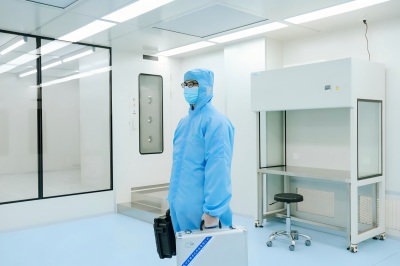
3. The Engineering Core: HVAC, Filtration & Pressure Control
The “clean” in cleanroom comes from the sophisticated interplay of air management components.
Integrated HVAC Systems
Dersion’s modular cleanroom solutions feature dedicated HVAC units designed for 24/7 reliability.
- HEPA/ULPA Filtration: Capturing 99.99% of particulates down to 0.3μm.
- Pressure Gradients: Automated damping systems maintain a 10-15 Pa differential to ensure air flows from clean to less-clean zones.
Airflow Patterns
- Unidirectional (Laminar): For ultra-clean zones where particles must be “swept” away instantly.
- Turbulent Flow: Cost-effective for larger ISO 7/8 areas with high air change rates (ACR).
4. Calculating ROI: Beyond the Initial Investment
While the upfront cost of modularity is competitive, the true value is found in the Total Cost of Ownership (TCO).
Energy Efficiency
By using high-efficiency FFU motors and intelligent Building Management Systems (BMS), Dersion clients often see energy savings of up to $21,600 per year for medium-sized facilities.
Financial Benefits
- Accelerated Depreciation: In many jurisdictions (like the US), modular systems are treated as “equipment” rather than “real estate,” offering significant tax advantages.
- Reduced Validation Time: Standardized components come with pre-vetted documentation, slashing the time required for IQ/OQ/PQ.
5. Industry-Specific Use Cases
Cleanrooms are not “one size fits all.” Each industry has unique contamination control strategies (CCS).
- Pharmaceuticals: Focus on sterility and chemical resistance (HPL panels).
- Semiconductors: Focus on ESD (Electrostatic Discharge) control and VOC (Volatile Organic Compound) management.
- Biotechnology: Focus on biological containment and easy-to-clean coved corners.
6. The Dersion Turnkey Process: 8-12 Weeks to Excellence
Our global reputation is built on a “single-point-of-contact” delivery model.
- 1 Consultation & Concept: Understanding your URS (User Requirement Specification).
- 2 Detailed Engineering: BIM modeling and airflow simulation.
- 3 Global Logistics: Secure shipping to US, Europe, or Middle East.
- 4 Rapid Installation: Certified teams ensure the 8-12 week timeline is met.
- 5 Validation Support: Providing all necessary QA documentation for [ISO & GMP Certification]
Conclusion: Your Future-Proof Cleanroom Starts Here
Selecting the right modular cleanroom solution is a strategic decision that affects your product quality and your bottom line. With Dersion, you get a partner dedicated to technical precision, global compliance, and rapid delivery.
Post time: Jul-25-2026