Introduction In the high-stakes world of pharmaceutical and semiconductor manufacturing, the facility itself is a precision instrument. For decades, “stick-built” or traditional construction was the only option. However, as global markets demand faster timelines and higher flexibility, modular cleanroom solutions have fundamentally shifted the paradigm. If you are planning a new facility, understanding the trade-offs between modular and traditional construction is critical to your long-term success.
1. Installation Speed and Time-to-Market
Traditional construction is linear: you cannot start interior work until the shell is complete.
Traditional: Months of on-site labor, weather delays, and messy material handling.
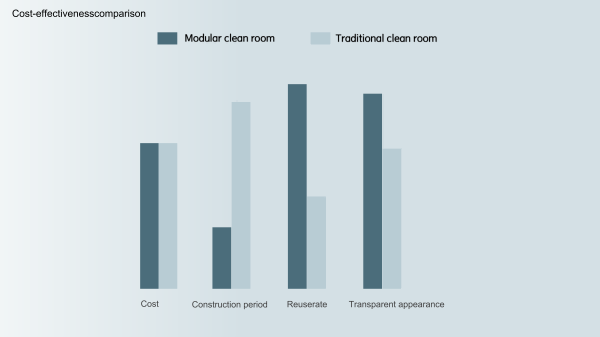
Dersion’s Modular Advantage: Our components are prefabricated in parallel with your site preparation. This “fast-track” approach typically results in a 50% reduction in installation time, allowing you to start production and generate revenue months earlier.
2. Flexibility and Future-Proofing
A facility built today must be able to adapt to tomorrow’s technology.
Traditional: Permanent walls are difficult and expensive to move, often resulting in significant material waste and production downtime during expansion.
Dersion’s Modular Advantage: Our sandwich panels are 100% reusable and reconfigurable. Whether you need to expand an ISO 7 zone or move an entire laboratory to a new location, modularity offers a level of scalability that traditional methods cannot match.
3. Site Disruption and Contamination Control
Constructing a cleanroom inside an existing active facility poses a massive risk of cross-contamination.
Traditional: Cutting drywall, sanding, and painting on-site create immense amounts of dust and VOCs (Volatile Organic Compounds).
Dersion’s Modular Advantage: With 90% of the fabrication happening in our factory, on-site work is primarily assembly. This minimizes dust, noise, and vibration, protecting your existing operations and simplifying your GMP Compliance protocols.
4. Financial Perspective: ROI and Depreciation
While the upfront cleanroom construction cost might look similar, the lifecycle value differs significantly.
Tax Benefits: Modular systems are often classified as equipment, qualifying for accelerated depreciation (e.g., IRS Section 179 in the US), whereas traditional rooms are treated as permanent real estate.
Operational Uptime: Faster builds mean a quicker ROI, turning a capital expense into a profit center in record time.
Conclusion
Traditional construction still has its place in large-scale infrastructure, but for controlled environments where precision and speed are non-negotiable, modularity is the clear winner. Dersion’s expertise in high-performance modular systems ensures that your facility is not just built—it’s engineered for growth.