
Class 100 (ISO Class 5) cleanrooms, according to the ISO 14644 standard, are among the highest cleanliness levels. So, how should FFUs, air conditioning, and lighting be arranged in a high-cleanliness cleanroom?
Actually, as long as we understand the core principles of a Class 100 cleanroom, we can easily plan its layout. The core of Class 100 cleanroom design is to achieve and maintain “unidirectional, vertical, and uniform” airflow to control particles and ensure cleanliness.
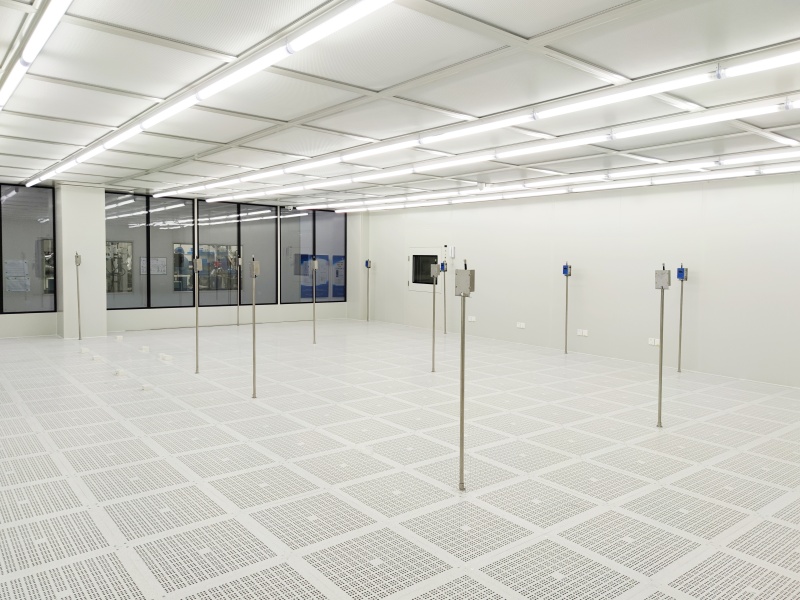
Therefore, FFUs (Fan Filter Units), air conditioning, and lighting should be planned according to the principle of “airflow priority and functional adaptation.” Specific requirements are as follows:
I. FFUs (Fan Filter Units): The ceiling of the Class 100 cleanroom should be fully covered. FFUs are the core purification equipment, and their layout must adopt a full-coverage scheme, that is, densely covering the entire ceiling with FFUs, with a coverage rate typically exceeding 80%. This design ensures that clean air is pushed downwards evenly and vertically, like a piston, rapidly pressing contaminants towards the return air vents on the raised floor, forming a unidirectional laminar flow, thus effectively protecting the work area. The uniform distribution of FFUs is key to avoiding airflow dead zones and maintaining the cleanliness level.
II. Air Conditioning and Airflow Organization: Class 100 Cleanroom Designed with Top Supply and Bottom Return. The cleanroom’s air conditioning system must be linked to the FFUs. Clean air treated by the FFUs is delivered vertically downwards and then coordinates with the return air vents on the raised floor to ensure orderly downward airflow. This “top supply and bottom return” mode efficiently removes particles generated by equipment and personnel. The air conditioning unit is responsible for handling the return air, regulating temperature and humidity, performing secondary filtration, mixing it with fresh air, and then distributing it to the FFUs via a plenum chamber, forming a closed loop.
III. Lighting Layout: Integrated with FFU Modules. Class 100 cleanroom lighting fixtures must be dustproof, anti-static, and glare-free LED cleanroom lights, recessed and flush with the ceiling for sealing, avoiding dust accumulation and airflow disturbance. LED teardrop lights are typically used, installed below the HEPA filter frame. These lights minimize airflow obstruction, ensuring uniform illumination while maintaining unidirectional flow stability (>300 lx). They are evenly distributed above the work area to avoid shadows.
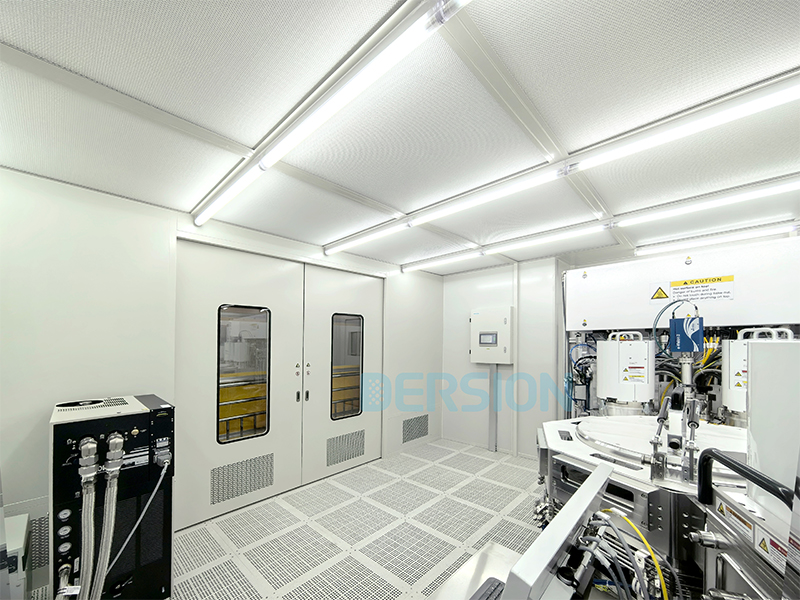
The layout of a Class 100 cleanroom is a complex system. A laminar flow core is created by covering the ceiling with FFUs (Fan Filter Units), orderly airflow is constructed from the lower return air, and lighting and other facilities are highly integrated into the ceiling layout. These three elements work in perfect harmony to construct a stable and efficient clean environment.
Post time: Dec-10-2025