
How Do Cleanrooms Achieve a Dust-Controlled Environment?
A “dust-free” cleanroom is not an environment completely free of particles. Instead, it is a highly engineered space designed to strictly control the concentration of airborne particles within defined limits, in accordance with standards such as ISO 14644 or GMP.
This level of control is achieved through an integrated system that manages air quality, airflow patterns, personnel behavior, material movement, and architectural design. Among these elements, the air purification and ventilation system plays the most critical role.
1. Advanced Air Filtration: The Core of Cleanroom Performance
Cleanrooms rely on a multi-stage air filtration system to remove contaminants before air enters the controlled space:
-
Pre-filters capture large dust particles and extend the service life of downstream filters
-
Medium-efficiency filters remove finer particulate matter
-
HEPA or ULPA filters eliminate particles ≥0.3 microns with efficiencies of 99.99% or higher
This filtration process ensures that only highly purified air is supplied to the cleanroom, forming the foundation of contamination control.
2. Controlled Airflow Design: Continuous Particle Removal
Beyond filtration, airflow organization determines how effectively particles generated inside the cleanroom are removed:
-
Laminar (unidirectional) airflow is typically used in ISO Class 5–6 (Class 100 / Class 1,000) cleanrooms, where clean air flows in parallel streams to sweep particles away from critical zones
-
Turbulent (non-unidirectional) airflow is commonly applied in ISO Class 7–8 (Class 10,000 and below) environments, where well-mixed airflow continuously dilutes and removes contaminants
In both cases, airflow is carefully directed toward return air grilles, maintaining a continuous cleansing effect.
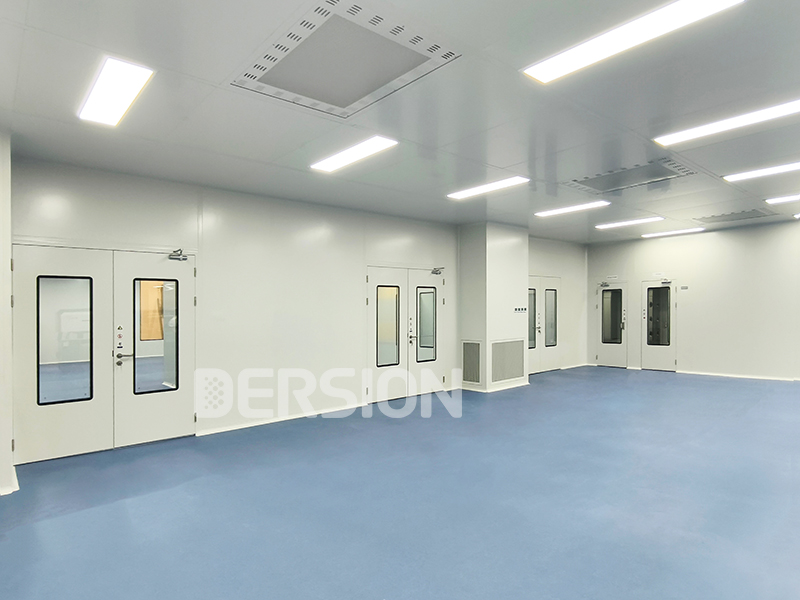
3. Positive Pressure Control: Preventing External Contamination
Cleanrooms are designed with positive pressure ventilation, meaning the internal air pressure is higher than that of surrounding areas. This pressure differential prevents unfiltered air from entering when doors are opened.
For multi-room cleanroom facilities, pressure gradients are established between rooms of different cleanliness levels to minimize cross-contamination and protect critical processes.
4. Personnel & Material Control: Managing the Largest Contamination Sources
Human activity is the largest source of particles in any cleanroom. To mitigate this risk:
-
Personnel must pass through air showers, where high-velocity HEPA-filtered air removes dust, hair, and loose particles
-
Cleanroom garments—including suits, shoes, gloves, masks, and hoods—are mandatory to minimize particle shedding
Materials entering the cleanroom are equally controlled:
-
Items are cleaned in buffer rooms before entry
-
Pass-through boxes or material air showers are used to avoid direct door opening and airflow disruption
5. Cleanroom Construction & Operational Management
Cleanroom architecture and daily management ensure long-term performance:
-
Smooth, non-shedding wall, ceiling, and floor materials prevent dust accumulation and allow easy cleaning
-
Rounded corners and sealed joints eliminate dead spaces where contaminants could collect
-
Airtight doors, windows, and penetrations prevent external particle infiltration
-
Equipment layout is optimized to reduce turbulence and unnecessary personnel movement
Regular cleaning, monitoring, and preventive maintenance are essential to sustaining cleanroom performance over time.
Conclusion
A cleanroom is not a static “dust-free box,” but a dynamic contamination-control system. Through continuous air purification, controlled airflow, pressure management, disciplined personnel and material handling, and precision-engineered construction, cleanrooms achieve reliable particle control that meets the stringent requirements of industries such as pharmaceuticals, medical devices, electronics, biotechnology, and semiconductor manufacturing.
Post time: Jan-20-2026