
In the food manufacturing industry, food portioning (food repackaging or subdividing packaging) refers to the controlled process of dividing bulk packaged food into smaller retail-ready units under hygienic and regulated conditions. This operation is widely used in retail supply chains, ready-to-eat food production, and contract packaging facilities.
Because food portioning directly exposes products to the environment, even short contact with airborne particles, microorganisms, or human handling can significantly impact food safety, shelf life, and regulatory compliance.
To ensure product integrity, food portioning must be carried out in a controlled cleanroom environment designed in accordance with ISO 14644 and food GMP guidelines (such as EU Food Hygiene Regulations and FDA food safety principles).
1. Cleanroom Classification & Environmental Requirements
The required cleanroom class depends on product risk level and exposure time:
- Standard food portioning operations: ISO Class 8 (Class 100,000)
- High-risk operations (ready-to-eat / no further heat treatment): ISO Class 7 (Class 10,000) or higher
Under ISO 14644 standards:
- Particle concentration is strictly controlled for airborne contaminants ≥0.5 μm
- ISO Class 8 allows up to 3,520,000 particles/m³
- ISO Class 7 significantly reduces allowable particle limits for higher hygiene assurance
Microbiological control is equally critical:
- Airborne bacteria (CFU/m³): typically <100 CFU/m³
- Settling bacteria (CFU/plate): typically <10 CFU/plate
Temperature & Humidity Control
To inhibit microbial growth and maintain product stability:
- Temperature: 18°C – 26°C (64°F – 79°F)
- Relative humidity: 45% – 65% RH
Stable environmental conditions are essential to prevent condensation, mold growth, and bacterial proliferation.
2. Airflow Design & Pressure Control Strategy
A properly engineered HVAC system is the backbone of food cleanroom performance.
Airflow Organization
Most food portioning cleanrooms use turbulent (non-unidirectional) airflow, typically:
- Ceiling supply air
- Side or low-level return air
For ISO Class 8 environments:
- Minimum air change rate: 15–20 air changes per hour (ACH)
This ensures continuous dilution and removal of airborne contaminants.
Pressure Differentials (Critical for Contamination Control)
To prevent cross-contamination between zones:
- Cleanroom vs adjacent buffer area: ≥5 Pa positive pressure
- Cleanroom vs non-clean areas: ≥10 Pa positive pressure
Positive pressure ensures that airflow moves outward, preventing contaminated air ingress.
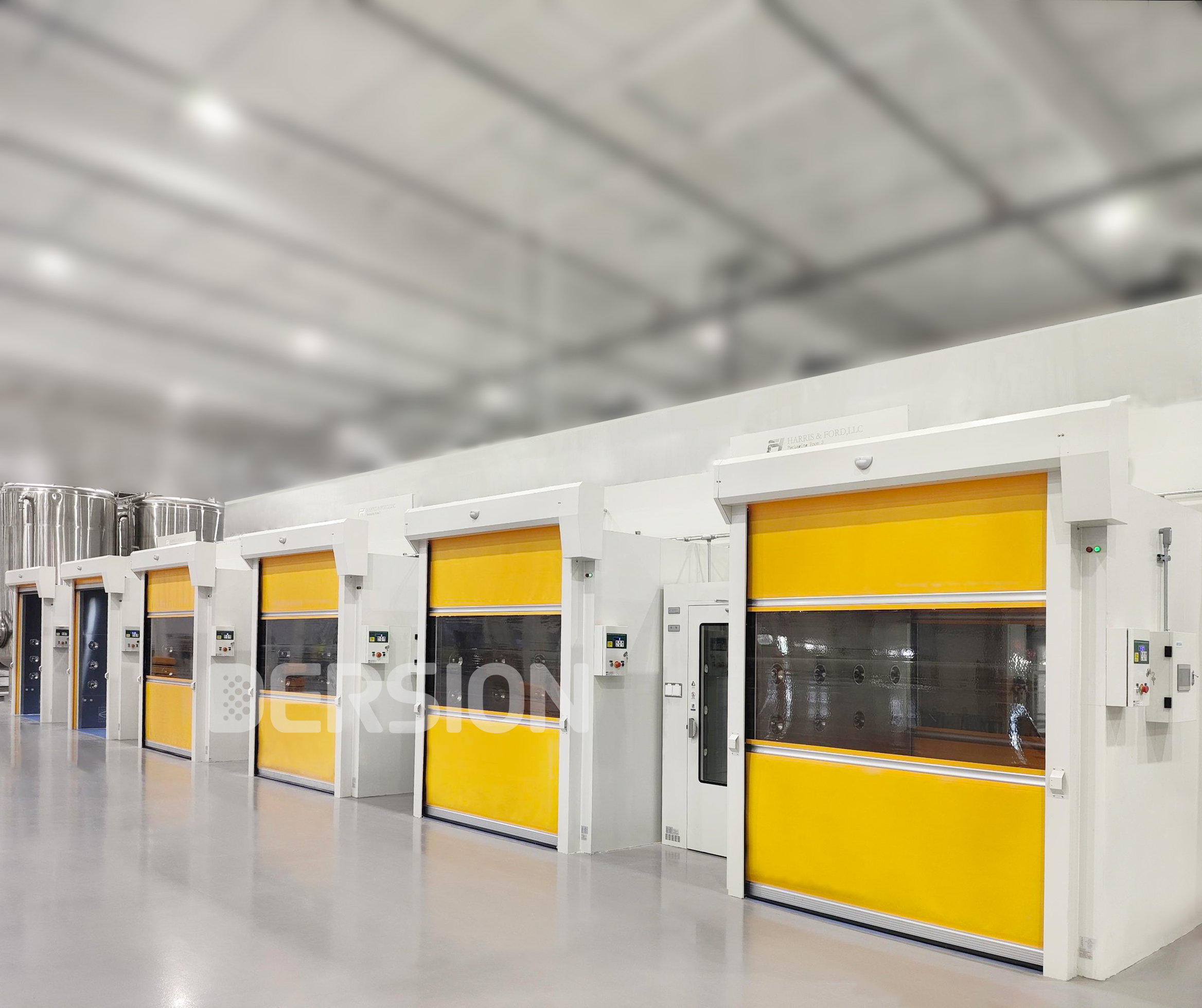
3. Hygienic Construction & Material Requirements
Food cleanrooms must be designed for cleanability, durability, and microbial resistance.
Recommended Materials:
- Walls: food-grade sandwich panels or antimicrobial coated panels
- Stainless steel: 304 or 316 stainless steel for high-hygiene areas
- Floors: seamless epoxy or PVC flooring with anti-slip and antimicrobial properties
- Ceilings: sealed modular cleanroom panels
Design Principles:
- Fully sealed joints to eliminate microbial traps
- Rounded corners (R-angle design) for easy cleaning
- Waterproof and moisture-resistant construction
- Integrated drainage slope for wash-down areas
- Airtight sealing for all pipe and cable penetrations
- High-performance airtight doors and controlled access windows
These design elements are critical for meeting FDA food hygiene expectations and EU GMP-like food production standards.
4. Personnel & Material Flow Control
Human activity is one of the largest contamination sources in food cleanrooms.
Personnel Hygiene Protocols:
Before entering the cleanroom, operators must follow:
- Multi-stage gowning procedures (protective clothing, gloves, masks, hairnets)
- Hand washing and sanitization
- Air shower (where applicable)
Restrictions include:
- No jewelry, cosmetics, or personal accessories
- Strict hygiene compliance training required
Material Transfer Control:
To prevent cross-contamination:
- Outer packaging must be removed in a non-clean area
- Materials pass through interlocked pass boxes
- UV sterilization or air-lock systems are often integrated
- One-way material flow is mandatory (dirty → clean direction only)
5. Key Compliance Considerations for Global Markets
For international food manufacturers, cleanroom design must align with:
- ISO 14644 Cleanroom Classification Standard
- FDA Food Safety Modernization Act (FSMA) principles
- EU Regulation (EC) No 852/2004 on food hygiene
- HACCP-based contamination risk control systems
Modern buyers increasingly evaluate cleanrooms not only by classification, but by:
- Validation capability
- Energy efficiency (HVAC optimization)
- Modular scalability
- Installation speed and downtime reduction
Conclusion
Food portioning cleanrooms are not simply controlled spaces—they are critical food safety barriers that directly determine product hygiene, compliance readiness, and market acceptance.
A properly engineered cleanroom system ensures:
- Stable microbial control
- Reduced cross-contamination risk
- Compliance with global food safety standards
- Extended product shelf life and consumer safety
For manufacturers targeting international markets, adopting a modular, compliant, and validated cleanroom design strategy is now a key competitive advantage.
Post time: Apr-29-2026