
Cleanroom Requirements for Face Mask Manufacturing
A dust-free workshop (cleanroom) is the fundamental guarantee of quality, safety, and consistency in face mask manufacturing. To meet international cosmetic GMP requirements and ensure product stability throughout the production lifecycle, cleanrooms must comply with strict standards covering cleanliness classification, environmental control, materials, personnel management, and continuous monitoring.
1. Cleanliness Classification by Process Risk
Face mask production cleanrooms should be classified based on contamination risk and process criticality:
-
ISO Class 8 (Class 100,000)
Suitable for outer packaging areas and raw material pre-processing zones where there is no direct contact with the product. -
ISO Class 7 (Class 10,000)
Required for core production areas that directly contact the mask substrate or essence, such as filling, soaking, and inner packaging. -
ISO Class 6 (Class 1,000)
Recommended for critical processes such as essence preparation and compounding to minimize particulate and microbial contamination. -
ISO Class 5 (Class 100)
Applied to highly sensitive products, including eye masks, infant masks, or premium functional masks, ensuring near-zero contamination in critical operations.
This zoning strategy aligns with international cleanroom standards (ISO 14644) and cosmetic GMP best practices.
2. Environmental Control: Temperature, Humidity & Microbiology
Precise environmental control is essential to maintain product stability and prevent contamination:
-
Temperature: Controlled at 20–26°C, preventing phase separation, degradation, or instability of mask essence.
-
Relative Humidity: Maintained at 45–65% RH to inhibit microbial growth, prevent packaging deformation, and reduce electrostatic particle attraction.
For hydrogel masks, RH is typically controlled below 50% to avoid stickiness. -
Microbial Limits:
-
Settling bacteria: <10 CFU / 0.5h
-
Airborne bacteria: <500 CFU/m³
-
-
Airflow Design:
Vertical unidirectional airflow or mixed-flow systems are commonly adopted to ensure uniform air distribution and rapid particle removal. -
Pressure Control:
Cleanrooms operate under positive pressure, with:-
≥5 Pa between adjacent clean areas
-
≥10 Pa between clean and non-clean areas
This pressure gradient effectively prevents external contaminants from entering critical zones.
-
3. Cleanroom Materials & Equipment Standards
All materials and equipment used in face mask cleanrooms must be designed for cleanliness, durability, and easy sanitation:
-
Production Equipment:
Made of food-grade or pharmaceutical-grade stainless steel, featuring smooth surfaces and resistance to corrosion. UV or ozone disinfection systems are often integrated, with routine cleaning validation. -
Floors:
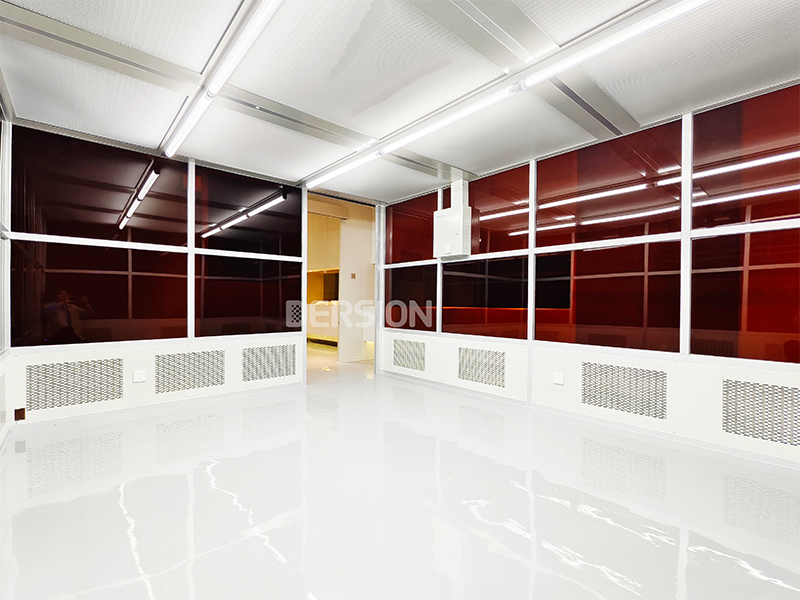
Seamless epoxy self-leveling floors or anti-static PVC flooring to prevent dust accumulation and microbial growth. -
Walls & Ceilings:
Smooth, dust-free color steel panels with rounded corners (coving) to eliminate dead zones and facilitate cleaning.
This construction approach ensures compliance with GMP, ISO cleanroom, and international cosmetic manufacturing standards.
4. Personnel & Material Flow Control
Strict segregation of personnel and materials is critical to prevent cross-contamination:
-
Personnel Control:
Cleanroom operators must wear anti-static, dust-free garments, gloves, hair covers, and masks. Jewelry and personal items are prohibited. Entry is only permitted after passing through air showers and gowning rooms. -
Material Control:
All incoming materials undergo external packaging cleaning, disinfection, and transfer through airlocks or pass boxes before entering clean areas.
A well-designed personnel and material flow layout is essential for stable and compliant cleanroom operations.
5. Continuous Monitoring & Compliance Verification
To ensure long-term compliance, a comprehensive monitoring system must be implemented:
-
Regular testing of particle counts, airborne and settling microorganisms, temperature, humidity, and differential pressure
-
Continuous data recording, trend analysis, and documentation
-
Compliance with Cosmetic GMP, ISO 14644, and applicable regional regulations (EU, FDA, ASEAN, etc.)
Ongoing verification ensures that the cleanroom consistently meets regulatory and quality requirements throughout production.
Post time: Jan-20-2026