
In scientific research, biopharmaceuticals, and precision manufacturing, many clients choose to build cleanroom labs to complete their work. At this point, some may wonder: isn’t a regular lab sufficient? Why spend so much money on a cleanroom? The answer is: cleanroom labs and regular labs are fundamentally different. Making the wrong choice can lead to product scrapping at best, and quality and safety crises at worst. Below are 10 key differences, which DERSION will help you quickly understand why cleanroom labs are irreplaceable.
1. Core Mission: Controlling Contamination vs. Providing a Venue The core of a regular lab is “having a place to conduct experiments,” providing a testing site; while the core of a cleanroom lab is “producing contamination-free products in a controlled environment.”
2. Air Cleanliness: Counting Particles vs. “Seeing is Believing” This is the most crucial difference between regular and cleanroom labs. Cleanroom laboratories have stringent standards for the number and size of suspended particles per cubic meter of air, such as ISO Class 5 (Class 100); ordinary laboratories do not have such requirements.
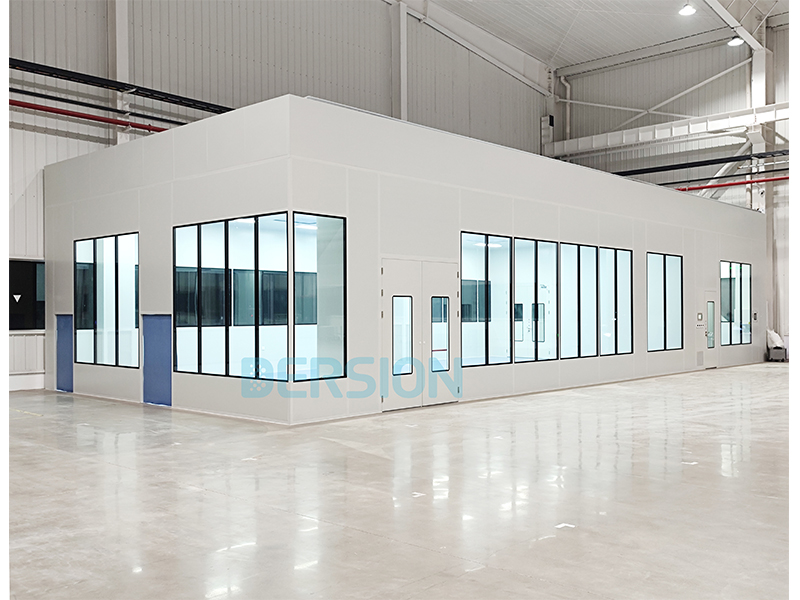
3. Ventilation and Airflow: Unidirectional/Turbulent Flow vs. Ordinary Air Exchange. Cleanroom laboratories use high-efficiency particulate air (HEPA/ULPA) filters and carefully designed airflow to continuously “blow away” contaminants; ordinary laboratories only require basic ventilation.
4. Differential Pressure Control: Positive Pressure Protection vs. No Control. Cleanroom laboratories typically need to maintain positive pressure to prevent the inflow of dirty air from outside; ordinary laboratories do not have this design.
5. Temperature and Humidity Control: Precise Control vs. Basic Range. Cleanroom laboratories require high-precision control of temperature and humidity, such as temperature ±0.5℃, to ensure process stability; the control range of ordinary laboratories is much more lenient.
6. Building Materials and Surfaces: Smooth, Dust-Free vs. Conventional Materials. Cleanroom laboratory walls, floors, etc., need to be made of smooth, seamless, dust-free materials, such as epoxy and PVC; ordinary laboratories often use ceramic tiles, cement, etc. 7. Personnel Attire: Spacesuit-Level Protection vs. White Lab Coats. Entering a cleanroom laboratory requires passing through an air shower and wearing specialized cleanroom suits, gloves, and masks; ordinary laboratories typically only require white lab coats.
8. Material Access: Strict Purification vs. Direct Bring-In. All materials and tools entering a cleanroom laboratory must undergo strict cleaning and disinfection procedures, such as buffer rooms and pass-through windows; ordinary laboratories do not have this process.
9. Management and Monitoring: Real-Time Data Monitoring vs. Periodic Recording. Cleanroom laboratories require continuous monitoring and recording of parameters such as particle count and pressure differential; ordinary laboratories have relatively simpler management.
10. Application Areas: High-Tech Industries vs. R&D. Cleanroom laboratories are typically used in fields such as chip manufacturing, sterile pharmaceutical products, and aerospace; ordinary laboratories are used for teaching and routine chemical analysis.
In summary, if your process has “zero tolerance” for microorganisms and dust particles, then a cleanroom or clean laboratory is not an “option,” but a “necessity.”
It is a solid quality defense line, protecting the lifeline of your products and the reputation of your company. If you would like to learn more, please contact us immediately to obtain professional cleanroom laboratory solutions!
Post time: Dec-10-2025