
Cleanrooms impose extremely strict requirements on environmental control, including particle concentration, static electricity management, cleanability, and long-term operational stability. As a result, flooring systems must do far more than simply support foot traffic—they are a critical component of contamination control and facility performance.
Among the many flooring options available, PVC flooring, epoxy self-leveling flooring, and raised access floors have become the most widely adopted solutions worldwide. This is because each of these systems addresses specific cleanroom challenges and aligns with international cleanroom standards and industry practices.
1. PVC Flooring: Practical, Anti-Static, and Easy to Maintain
PVC cleanroom flooring is widely used in ISO Class 6–8 (Class 1,000–100,000) environments, especially in electronics, semiconductor assembly, and medical manufacturing.
PVC sheets or tiles are typically installed with hot-welded seams, creating a continuous, seamless surface that prevents dust accumulation and microbial growth. The smooth, non-porous finish makes routine cleaning fast and efficient, requiring only damp mopping or neutral detergents.
From a performance standpoint, PVC flooring offers:
-
Excellent anti-static capability, achieved through conductive layers or carbon-based additives that safely dissipate static electricity
-
Comfortable underfoot resilience, reducing fatigue for operators working long shifts
-
Good wear and scratch resistance, suitable for frequent personnel and equipment movement
-
Flexible design options, with multiple colors and patterns supporting zoning and visual management
In addition, PVC flooring allows localized replacement if damaged, reducing downtime and long-term maintenance costs—an important consideration for continuously operating cleanrooms.
2. Epoxy Self-Leveling Flooring: High Cleanliness and Long-Term Durability
Epoxy self-leveling flooring is the preferred solution for high-cleanliness and high-load cleanrooms, including pharmaceutical GMP facilities, precision electronics production, chemical laboratories, and biosafety environments.
This system uses liquid epoxy resin that naturally levels during installation, forming a seamless, mirror-smooth surface with exceptional flatness. Once cured, it creates a fully sealed floor layer that:
-
Prevents dust and moisture migration from the substrate
-
Eliminates joints where particles could accumulate
-
Resists acids, alkalis, solvents, and aggressive cleaning agents
Epoxy self-leveling floors also provide high mechanical strength, capable of supporting heavy equipment and long-term operation. With proper installation and maintenance, service life can exceed 10 years, significantly reducing renovation frequency and lifecycle costs.
For clients seeking a robust, hygienic, and highly controlled cleanroom base, epoxy self-leveling flooring functions as a protective foundation that supports the most stringent cleanliness standards.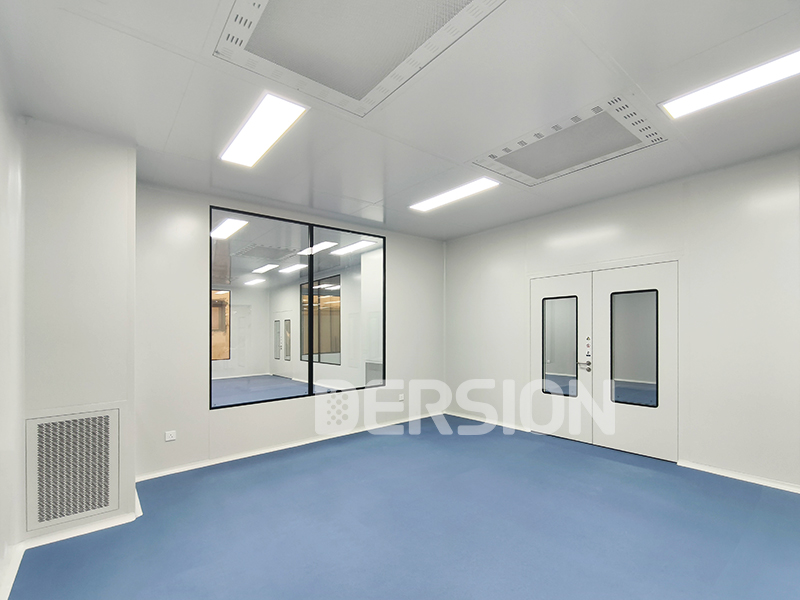
3. Raised Access Flooring: Flexibility, Airflow Optimization, and Infrastructure Integration
Raised access floors are widely adopted in semiconductor fabs, optoelectronics facilities, data-intensive cleanrooms, and precision manufacturing environments where flexibility and infrastructure density are critical.
This modular system consists of anti-static floor panels supported by adjustable pedestals, creating a 30–100 cm underfloor service plenum. This space enables:
-
Concealed routing of electrical, data, gas, pure water, and HVAC systems
-
Underfloor air supply configurations that optimize airflow patterns and particle control
-
Easy access for maintenance, upgrades, or future process changes
The adjustable structure allows the floor to compensate for uneven substrates and adapt to evolving equipment layouts—without cutting trenches or disturbing the cleanroom envelope. As a result, raised flooring significantly enhances long-term operational flexibility while protecting cleanroom integrity.
Conclusion: A Complementary Flooring Strategy for Modern Cleanrooms
Each of these flooring systems serves a distinct role within a cleanroom:
-
PVC flooring excels in anti-static performance, comfort, and cost-effective maintenance
-
Epoxy self-leveling flooring delivers superior cleanliness, durability, and chemical resistance for core clean areas
-
Raised access flooring integrates airflow management and infrastructure flexibility for advanced manufacturing environments
By strategically selecting and combining these solutions based on cleanliness class, process requirements, and future scalability, cleanroom operators can achieve a dust-controlled, durable, and adaptable flooring system that supports stable production, regulatory compliance, and long-term return on investment.
Post time: Jan-20-2026